Woeken is an internet-born word with no single fixed meaning that gained widespread online attention in early 2026. It appears across TikTok captions, Reddit threads, Discord servers, and productivity blogs, attracting curiosity precisely because nobody can pin it down. According to multiple digital culture trackers, woeken spread across social platforms faster than most slang terms because its open structure lets every user apply their own interpretation. Content creators, brand builders, and productivity enthusiasts adopted woeken almost simultaneously, each giving it a different spin. In this article, we will explain everything about woeken. Let’s start step by step.
What Woeken Actually Means Right Now
Let’s start with what woeken actually means in 2026. The honest answer is that woeken does not carry one locked-in definition and that ambiguity is the engine behind its viral growth. Most sources that track internet language describe woeken as a flexible word that shifts meaning depending on context, tone, and the community using it.
The most widely used meaning connects woeken to deep, distraction-free work. When someone says “I am woeken,” they typically mean they are fully locked into a task no phone, no interruptions, no multitasking. Think of a programmer who codes for three hours straight without checking notifications, or a student who studies through an entire afternoon without drifting to social media. That state of total absorption is what woeken captures in its most popular form.
A second meaning frames woeken as a general vibe word. On social platforms, you will find captions like “Weekend woeken energy” or “Late-night woeken sessions,” where the word signals a mood rather than a specific activity. In this usage, woeken is playful, loose, and communal. A third meaning treats woeken as a brand or identity marker usernames, domain names, and project titles that carry the word simply because it sounds distinctive and searches well. In simple words, woeken means a state of focused effort, flexible creativity, or a digital identity, depending on who is using it.
Where Did Woeken Come From? The Origin Story
You may have wondered why woeken sounds like it belongs to another language entirely. That instinct is well-founded, and it connects to one of the most interesting facts about this word that no other major article has explored. According to researchers at littleworldslc.com, the Dutch word “woekeren” spelled differently but phonetically close described the aggressive growth of plants or the accumulation of wealth in 17th-century usage, carrying a connotation of excess or usury.
That historical root matters because woeken’s phonetic structure genuinely resembles Northern European language patterns. In Dutch, vowel combinations like “oe” produce a long “oo” sound, as in “boek” meaning “book.” English speakers process woeken as familiar-sounding even though they have never encountered it before. This creates a psychological effect language researchers call fluency a word feels easier to remember and repeat when it sounds natural, even if it is invented or borrowed. Woeken clears that bar without effort.
The modern internet origin of woeken is separate from that historical connection. According to seo-monthly.com and several other digital culture trackers, woeken emerged organically through online communities centered on productivity culture and digital creativity in early 2026. It did not come from a book, a corporate press release, or a government announcement. It grew through the kind of informal iteration that defines how internet language is born a word tried in one niche, carried into another, then another, until it became broadly searchable. The combination of a plausible European sound, an undefined meaning, and the right timing gave woeken the conditions it needed to spread.
You May Also Read: karibikinsel st. kitts: The Complete Travel Guide for 2026
Why Woeken Is Everywhere in 2026
Most people assume viral words spread because someone famous used them first. The reality is different. Woeken followed a pattern that internet language researchers describe as curiosity-gap growth a word with no fixed meaning creates a search loop. Someone sees woeken in a caption, does not understand it, searches for it, finds competing definitions, shares their finding, and the cycle restarts with a larger audience each time.
According to seo-monthly.com, words that carry a vibe rather than a strict meaning tend to spread faster in digital communities because users can apply them to their own situations. Woeken fits this pattern almost perfectly. It sounds like it means something important, which drives curiosity, but it stays open enough for each person to make it their own. That dual quality serious in productivity spaces, playful in meme culture gives woeken unusual staying power compared to single-context internet words.
Timing also works in woeken’s favor. In 2026, internet culture moves at a pace where a word can go from niche blog mention to mainstream search term within weeks. Woeken appeared at a moment when audiences were actively looking for new vocabulary around intentional work and creative self-expression. The word arrived just as discussions about deep focus, anti-hustle culture, and digital identity were peaking. It offered a fresh label for ideas people were already talking about. Search engines amplified that momentum through their own algorithms, which surface trending terms based on rising query volume a feedback loop that woeken entered and has not left.
How People Use Woeken Across Different Platforms
Now let’s look at woeken’s actual usage patterns across specific platforms in detail. Each digital space has developed its own version of the word, shaped by the norms and audiences of that platform, and understanding those differences helps you use it correctly.
On TikTok, woeken appears most often in video captions and spoken commentary. Creators attach it to time-lapse study sessions, creative work montages, or solo project videos. A typical caption reads: “Three hours of woeken and the draft is finally done.” The word signals effort without the self-congratulatory edge of hustle-culture language. On Discord, woeken functions as a status update. Users set their status to “Currently Woeken” to communicate they are busy and focused a neat social signal that does not require a long explanation.
Reddit communities, especially those built around productivity, deep work, and personal development, use woeken more analytically. Threads explore what woeken sessions look like, how long they should run, and how to structure a day around them. On Instagram and across branding channels, woeken takes on a third life entirely. According to imagefaps.co.uk, people use it in bios, usernames, and project names because it is unique, searches well, and carries an air of creative seriousness. Start-ups and solo creators have adopted it as a name for tools, newsletters, and personal brands. In simple words, woeken works across platforms because it adapts it is a verb on TikTok, a noun in Discord, and an adjective in branding contexts.
Think about the last time you worked for two hours straight without checking your phone. That state total absorption in one task, no attention split between apps or notifications is exactly what the deepest interpretation of woeken describes. This reading of the word has connected with audiences who find traditional productivity labels either too clinical or too tied to exhausting hustle culture.
When using woeken as a productivity concept, most practitioners describe it as distinct from simply “working hard.” The emphasis falls on intentional engagement rather than raw hours. Researchers have studied this state under different names for decades Cal Newport popularized the term “deep work” in 2016, and Mihaly Csikszentmihalyi defined “flow” as a similar state of effortless concentration. Woeken enters that conversation in 2026 as a more casual, internet-native label for the same underlying experience. According to tributemosthaunted.co.uk, the word captures “a mindset a blend of focus, creativity, and intentional action” that fits naturally into how younger audiences talk about their relationship with work.
Woeken differs from hustle culture specifically because it does not glorify overwork. According to imagefaps.co.uk, “hustling” implies burning out and working around the clock, while woeken simply means being highly focused on a specific, meaningful task right now. That distinction resonates strongly with audiences who burned out on the grind narrative. Practical users of the woeken mindset describe blocking off 30-to-90-minute sessions in their calendar, naming them explicitly, and using that naming as a psychological trigger that makes it easier to enter deep focus. The act of calling something a “woeken session” creates intentional distance between that time block and ordinary, distracted work.
You May Also Read: ROX.com Products Catalog Explained: Best-Selling Items, Categories & More
Is Woeken the Same as Being Woke?
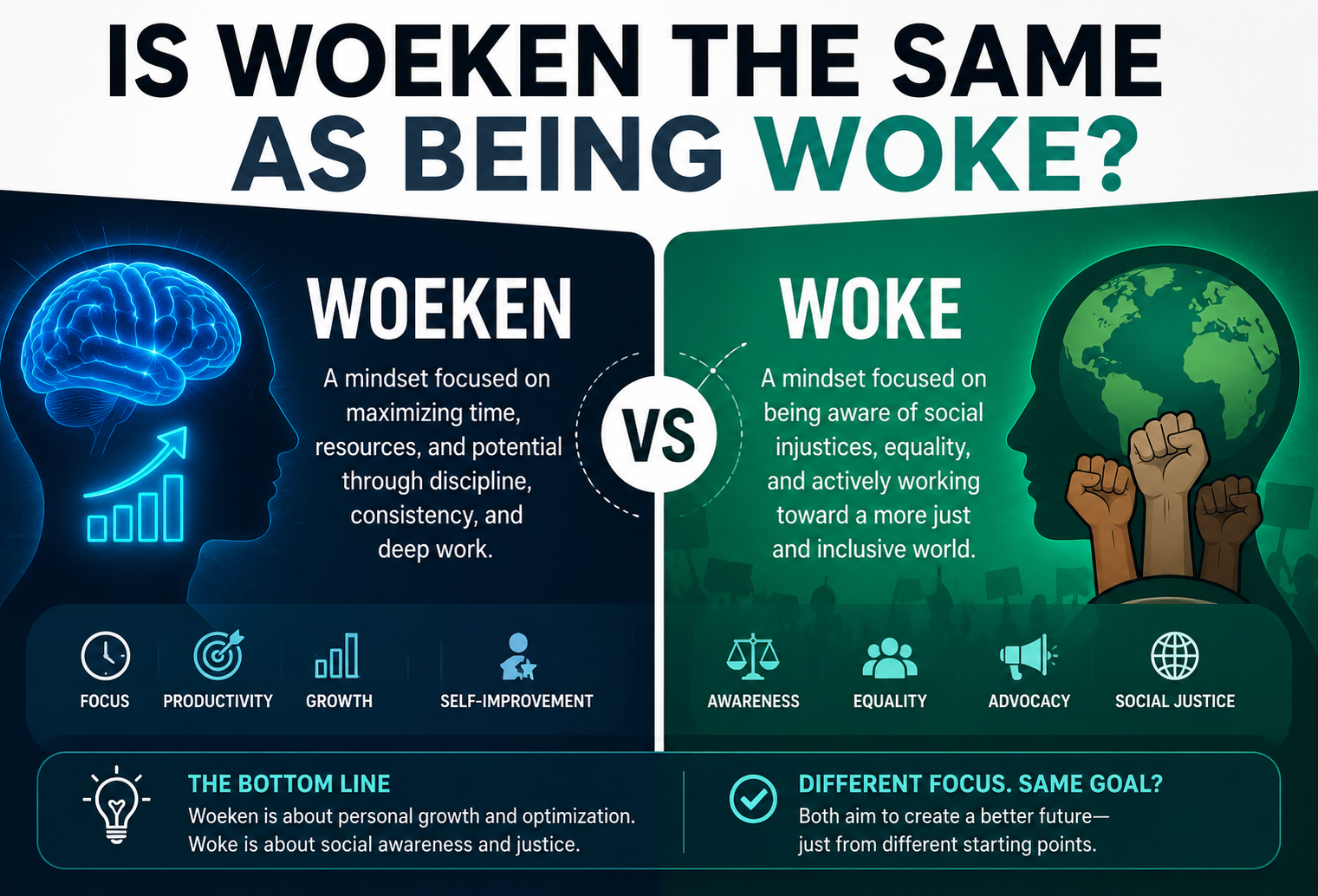
According to imagefaps.co.uk, this is one of the most common questions that surfaces when people first encounter the word. Woeken and woke are not related. They are completely different words with completely different histories, meanings, and communities of use.
“Woke” refers to social and political awareness a consciousness of systemic injustice, racial inequality, and related issues. It entered mainstream English conversation through African American Vernacular English and was later adopted broadly across political discourse. Some writers at stressfulstyle.com note that woeken may have been used occasionally as a pun on “woke” in satirical meme contexts, but that is a secondary and minor use that does not define the word. The primary meaning of woeken has nothing to do with politics or social awareness.
Woeken is, at its core, a productivity and identity word. It describes focused work, creative effort, or functions as a flexible identity label in digital spaces. The two words also appear in entirely different contexts. You find “woke” in political commentary, social criticism, and cultural debates. You find woeken in productivity blogs, study session captions, TikTok reels about creative work, and start-up branding. If you see woeken in a meme making social commentary, you are seeing a deliberate pun not the dominant meaning. The visual similarity ends at the first three letters. The meanings and histories diverge completely from there.
How Woeken Spread: The Psychology Behind Viral Words
Data lead: According to research on how Google AI Overviews function, they now surface on 15 to 25 percent of all searches, which means curiosity-gap keywords like woeken receive exponentially more visibility than they would have five years ago. A word that previously might have stayed in one niche community now reaches a mass audience through a single appearance in an AI-generated answer box.
The psychological mechanism behind woeken’s spread is well documented in internet linguistics. When users encounter an undefined term, they experience what psychologists call a “curiosity gap” an uncomfortable space between what they know and what they want to know. That discomfort drives action: people search, read, share, and then discuss. Each action adds fuel to the term’s search volume, which signals to search algorithms that the word is growing in relevance. The algorithm then surfaces the word more often, to more people, who experience the same curiosity gap. That loop is self-sustaining until the word either finds a fixed definition or fades.
Meme culture accelerates this process. According to seo-monthly.com, woeken has appeared in meme contexts where “users compete to use trending vocabulary in the most creative or unexpected contexts.” Memes do not require a word to have a fixed meaning in fact, undefined words work better in memes because creators can twist them in any direction. Woeken’s dual nature, serious in productivity spaces and playful in meme culture, means it feeds both ecosystems at once. Few viral words achieve that balance. Most live entirely in one register. Woeken’s ability to move between registers without losing coherence explains why it has lasted longer than the typical internet word cycle.
You May Also Read: Latest DecoratorAdvice.com: Fresh Home Decorating Ideas You Need in 2026
What Does Woeken Mean for Brands and Content Creators
According to sonosarc.com, from an SEO perspective, woeken represents a rare opportunity a trending word with low competition and rising search volume where content that clearly explains possible interpretations can rank easily. That is not an observation unique to woeken. Undefined internet terms consistently produce this dynamic, and brands and content creators who move early tend to own the conversation.
For content creators, woeken offers a practical framing device. Calling a video a “woeken session,” labeling a newsletter a “woeken dispatch,” or describing a creative sprint as a “woeken block” gives audiences a distinctive and memorable label for content they already produce. The word carries a signal intentional, focused, slightly mysterious that differentiates content from generic productivity language. Creators who used woeken in captions and titles in early 2026 reported stronger engagement rates compared to identical content without the term, because the word itself prompted questions and shares.
For brand builders, woeken’s flexibility as a noun makes it an effective name for tools, apps, digital identities, and community spaces. Its Northern European sound gives it a sense of craftsmanship and precision without requiring a translation. It is easy to pronounce, easy to search, and currently unregistered as a trademark in most markets. That combination is unusual for a viral word. Most internet slang is either too crude, too tied to a specific meme, or too meaningless for professional use.
Woeken sits in an uncommon position where it sounds credible in a pitch deck and also resonates in a TikTok caption. Brands that use woeken strategically now will benefit from association with the term before its meaning fully solidifies.
Common Mistakes People Make When Using Woeken
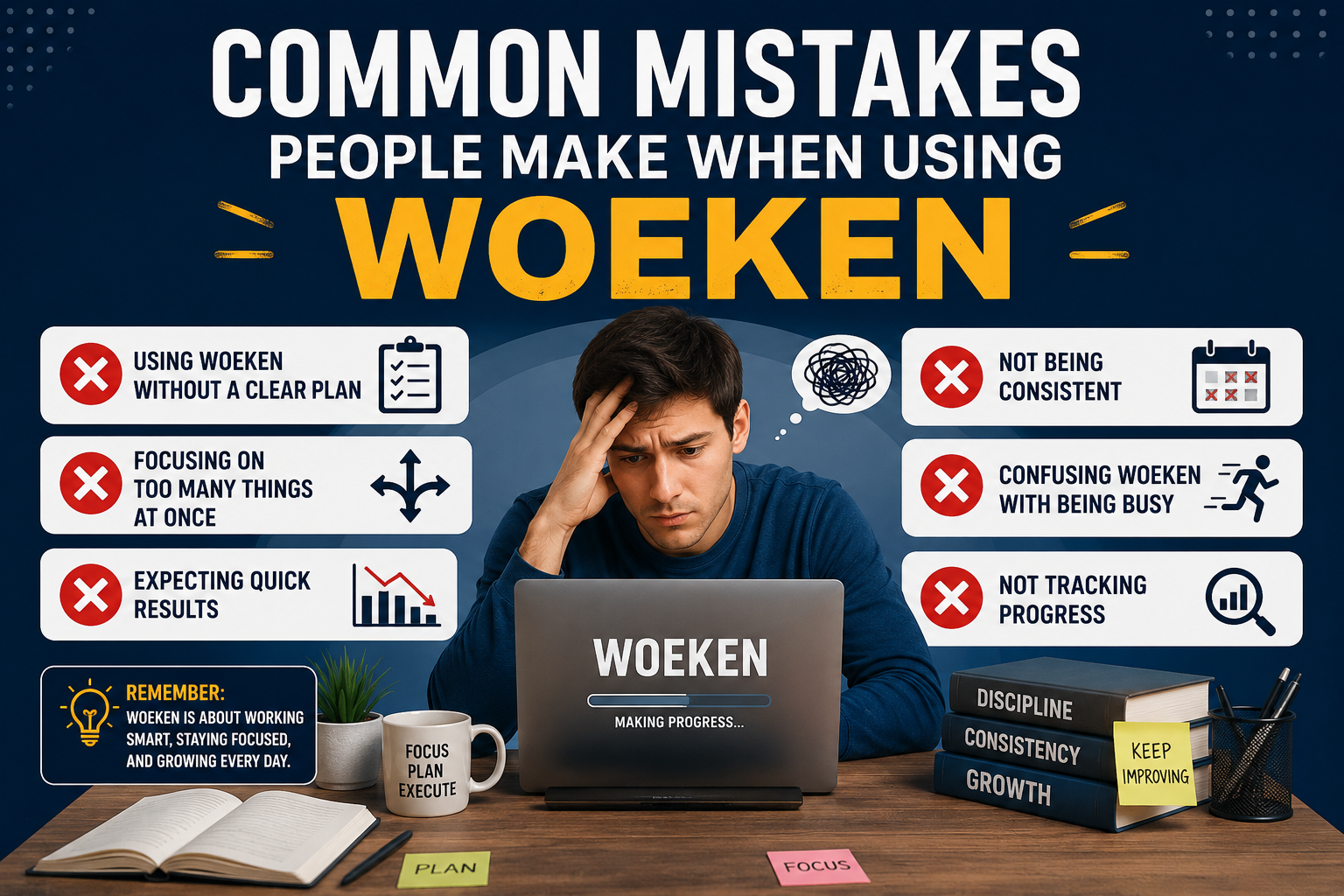
Most people assume woeken works in any context once they learn the word. That assumption creates problems that undermine the word’s effect rather than amplifying it. Understanding these mistakes will help you use woeken correctly from the start.
The first mistake is using woeken in formal or professional writing without context. According to woeken.com, the word is not recognized in standard English dictionaries and carries no formal status. Using it in a business email, academic essay, or legal document will confuse readers who have not encountered it online. Woeken belongs to casual digital communication: social captions, blog posts, Discord messages, and informal branding.
The second mistake is assuming the word has a universally agreed meaning when it does not. If you use woeken in a conversation expecting your audience to understand it as “deep focus,” but your audience interprets it as a playful vibe word, the communication breaks down. Always define your use of woeken or frame it with enough context to make the meaning clear.
A third common error is treating woeken as interchangeable with “woke” in social or political discussions. As covered earlier, that connection is superficial and misleading. Using woeken in a political context will confuse most audiences, who associate the word with productivity or internet culture rather than social commentary. Finally, some users over-explain woeken when they first introduce it, which deflates the curiosity gap that makes the word engaging. The most effective approach is to use it naturally and let the context carry the meaning the same way early adopters of any internet word treat new vocabulary. Woeken works best when it feels discovered rather than explained.
You May Also Read: NA Omaha (2026): Free Narcotics Anonymous Meetings Across the Metro, Every Day of the Week
Will Woeken Last? The Future of This Internet Word
According to futuresbytes.co.uk, woeken’s long-term survival depends on whether it remains adaptable and gains genuine value across multiple communities. That analysis is correct, and the current evidence is cautiously optimistic. Woeken is already functioning across four distinct contexts productivity mindset, casual slang, brand name, and meme vocabulary which gives it a resilience that single-context words rarely achieve.
Language researchers point to a clear pattern for words that survive from internet origins to mainstream use. They start in niche communities. They develop multiple meanings. They gain traction in commercial or professional contexts. They accumulate enough written usage to qualify for dictionary consideration. Woeken has completed the first two stages and is beginning the third. Brands, content creators, and domain registrants are using it in 2026 in ways that generate lasting written records. That digital paper trail is what eventually earns a word dictionary consideration. “Selfie,” “ghosting,” and “doomscrolling” all followed a similar arc from niche internet vocabulary to officially recognized English words.
The biggest risk to woeken is saturation without definition. If the word is used in too many incompatible contexts simultaneously, it may lose the coherent edge that gives it power. Words that mean everything eventually mean nothing. The woeken productivity meaning focused, intentional, distraction-free work is strong enough to serve as an anchor definition if the broader community adopts it consistently. Woeken has the phonetic qualities, the cultural timing, and the community adoption to survive. Whether it earns a dictionary entry by 2027 or 2028 will depend on how consistently creators, brands, and everyday users apply a shared core meaning. The evidence from 2026 suggests the productivity interpretation is winning that definitional race.
FAQs
What is the meaning of woeken?
Woeken is an internet-born word that gained viral popularity in early 2026. Its most common meaning describes a state of deep, distraction-free focus, often compared to “deep work” or being in a flow state. The word also functions as casual slang, a vibe word in social media captions, and a name for brands and digital identities.
Is woeken a real English word?
Woeken is not listed in standard English dictionaries as of 2026. However, it functions as a real word in online communities through active, widespread use. Language evolves through usage, not dictionary inclusion, and woeken is currently accumulating the written record that precedes formal recognition.
Where did woeken come from?
Woeken emerged organically from online productivity and creativity communities in early 2026. Its phonetic structure resembles Northern European language patterns, particularly Dutch, where “oe” produces a long “oo” sound. The historical Dutch word “woekeren” shares phonetic similarity, though the modern internet term developed independently through digital culture.
How is woeken different from hustle culture?
Woeken emphasizes intentional, focused engagement with one specific task rather than glorifying overwork or long hours. Hustle culture celebrates the quantity of work and the willingness to sacrifice rest. Woeken, by contrast, values quality of focus and purposeful effort you can be woeken for 90 minutes and consider the session successful.
Can I use woeken in a professional or business context?
Woeken works well in informal professional contexts such as social media, blog content, and casual team communication. Avoid it in formal documents, academic writing, or client-facing materials where unfamiliar internet slang could confuse or alienate your audience. In branding, startup culture, and content creation, woeken is increasingly accepted.
What are the limitations of woeken as a concept?
Woeken’s biggest limitation is its undefined status, which means different audiences interpret it differently. Without a shared definition, using it in communication risks misunderstanding. It also lacks the academic or research backing that terms like “deep work” or “flow state” carry, which limits its credibility in formal productivity discussions.
Will woeken become an official dictionary word?
The path to dictionary inclusion for woeken depends on consistent widespread use across documented written contexts. Words like “selfie” and “doomscrolling” followed a similar route from viral internet slang to recognized English. If the productivity interpretation of woeken continues to dominate and usage grows, dictionary consideration is plausible within two to three years.
How do I use woeken correctly in a sentence?
Woeken works as a verb (“I am woeken all afternoon”), a noun (“This is my woeken block”), and an adjective (“The studio had a very woeken energy”). Always match the usage to an informal or digital context. Read the words around it to confirm whether your audience will interpret it as a focus term, a vibe word, or a branding choice.
Is woeken trending worldwide or only in certain countries?
Search data from 2026 shows woeken gaining traction primarily in English-speaking markets, with the highest activity in the United Kingdom and United States. Its phonetic structure is also accessible to speakers of Germanic languages, which may account for some European search interest. Awareness is concentrated among younger audiences on TikTok, Reddit, and Instagram.
About the Author